
Hathor
Goddess of Joy
Joy is not indulgence.
It is alignment made visible.
— Wicked
Across every culture and every age, humanity has given names and faces to the forces that shape existence. Goddesses and Gods are not distant myths locked in the past — they are living archetypes, expressions of power, consciousness, nature, and cosmic law.
Within the Grimoire, deities are honored as embodiments of specific energies: creation and destruction, love and war, wisdom and chaos, death and rebirth. Each carries their own mythology, symbols, correspondences, and lessons, yet all emerge from the same universal source.
Goddesses appear here first, not as lesser counterparts, but as primordial forces of creation, transformation, and sovereignty. Gods follow as agents of order, motion, and manifestation. Together, they form a divine balance — mirrors of the inner and outer worlds we navigate every day.
This section is a living archive. As the Grimoire grows, so too will the pantheons represented here. Whether you approach these deities through devotion, study, magic, or symbolism, you are stepping into a lineage as old as humanity itself.
Core Essence
Hathor is the living current of joy, devotion, beauty, music, and the sweetness that restores the spirit. She is not softness as weakness — she is nourishment as power.
She teaches that pleasure can be sacred, that celebration can be cleansing, and that love is not only romance — it is the force that draws life back into harmony when it has hardened into survival.
Hathor’s energy is the reminder that the heart is not an accessory. It is a compass. When it is honored, life becomes more coherent. When it is ignored, everything becomes heavy.
Correspondences
Element
Planetary Association
Day
Chakra
Metal
Crystals & Stones
Mythological Origins
Hathor’s myths carry the texture of ancient Egypt: temple music, sacred devotion, the radiance of beauty, and the power of emotional restoration. She appears as a goddess of love and joy, but also as a force that steadies the heart of the world.
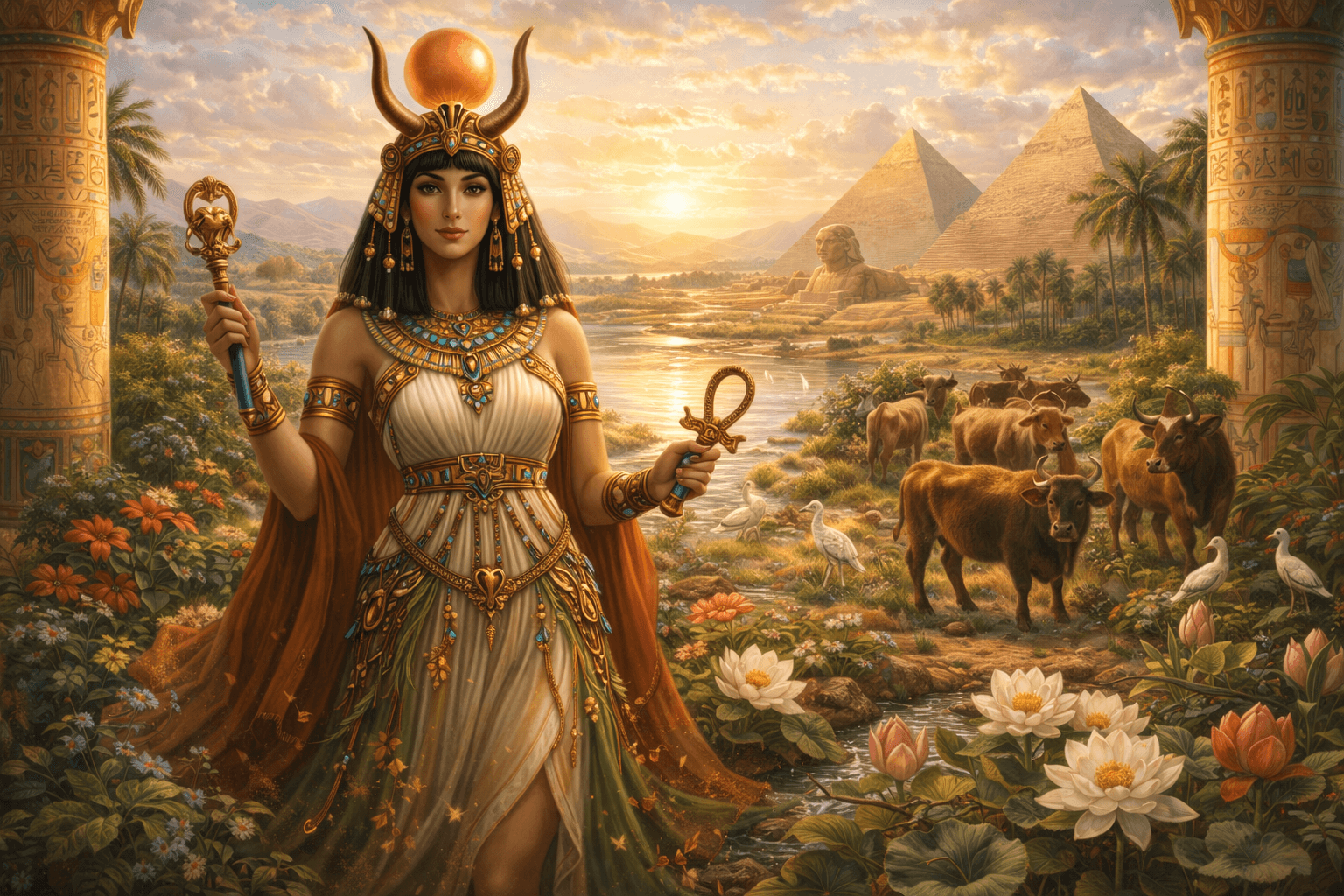
In her imagery, she is often crowned with horns and the sun disk — a symbol of sacred femininity, celestial blessing, and the ability to hold both tenderness and authority without contradiction.
Her stories teach that sweetness is not denial. It is medicine — a way the soul returns to itself after fear, grief, and hardened survival.
Domains & Powers
Hathor governs joy, devotion, beauty, music, pleasure, love, and the restoration of the heart. She supports healing that happens through softness without fragility — the kind of healing that makes a person more sovereign, not more dependent.
Her current strengthens receptivity. Not chasing. Not bargaining. Receiving what aligns when you stop treating yourself like you must earn tenderness.
She also carries the power of rebalancing after intensity. When the nervous system has been trained to brace, Hathor teaches the body how to exhale.
Symbols & Sacred Imagery
Music, dance, temples, mirrors, offerings made with care, sacred adornment, and the iconography of horns and the sun disk. Her imagery speaks to devotion that is beautiful because it is sincere.
Her symbols often point to a single truth: joy is a spiritual technology. It changes the field. It softens resistance. It reopens the channel of love.
Hathor in Practice
Work with Hathor when you want to restore joy without numbing: rebuilding self-worth, healing emotional hardness, welcoming love that does not cost you your dignity, and returning to pleasure as a sacred, stabilizing force.
She is powerful for devotion work, glamour and attraction that is rooted in self-respect, creative expression, music as cleansing, and reclaiming the heart after grief or betrayal.
Hathor responds to sincerity, gratitude, and steady care. She does not respond well to desperation, frantic chasing, or trying to use beauty as a weapon. Her current is alignment, not manipulation.
How to Know if Hathor Has Chosen You
If Hathor has chosen you, your spirit begins to refuse deprivation. You may find yourself unable to tolerate relationships, environments, or routines that keep your heart closed. What once felt normal starts to feel heavy.
Her presence often awakens through beauty and devotion: music that moves you, creative urges, a desire to care for yourself with tenderness, and moments where you feel pulled toward softness that is strong and clean.
Signs may appear through synchronicities tied to love, joy, gold, sacred adornment, mirrors, temple imagery, or sudden emotional relief that feels like being returned to yourself.
Most of all, if Hathor has chosen you, your life begins to teach receptivity. You stop forcing. You stop chasing. You start receiving what matches your worth.
Offerings & Devotion
Traditional offerings can be simple and beautiful: clean water, honey, milk, bread, fruit, flowers, incense, or devotional music. The power is not in extravagance — it is in sincerity.
Acts of devotion can be non-material: creating beauty in your space, caring for your body without punishment, singing or dancing as prayer, and choosing joy as discipline rather than escape.
Hathor does not demand perfection. She responds to reverence — the choice to treat love and pleasure as sacred, not as something you have to bargain for.
Hathor vs Sekhmet
Hathor’s current is restoration through sweetness and devotion. Sekhmet’s current is restoration through heat and correction. They are not the same energy, and they should not be treated as interchangeable.
If Hathor teaches the heart to open, Sekhmet teaches the heart to stop tolerating what desecrates it. One is medicine through tenderness. One is medicine through fire. Both return the soul to truth.
Archetypal Expression
Hathor moves through the Healer of the Heart, the Devotional Muse, the Joy-Bringer, and the Sovereign Receiver — not as roles to perform, but as currents that restore worth and coherence.
In her highest expression, she is joy with integrity: pleasure that strengthens, love that does not cost you yourself, and beauty that is reverence rather than performance.
Shadow & Balance
Hathor’s shadow can appear when sweetness becomes avoidance — when pleasure becomes escape, when beauty becomes armor, or when love becomes bargaining.
Her corrective wisdom is simple: joy must be clean. If it costs your dignity, it is not devotion. If it requires self-abandonment, it is not love.
Hathor in the Modern World
Today, Hathor’s energy is seen wherever someone stops punishing themselves for having a heart. She appears when a person returns to music, creativity, softness, and self-care as sacred discipline.
She reminds you that joy is not something you earn after suffering. It is part of the path. It is a stabilizing force that makes you harder to break.
Closing Reflection
Hathor teaches that joy is not an afterthought — it is a stabilizing force. When life hardens into survival, she arrives to remind the heart how to soften without breaking and how to open without losing discernment.
She asks you to examine where you have treated pleasure as something to earn, delay, or apologize for. Joy that restores is not indulgence. It is nourishment that allows the spirit to remain whole.
Walk with Hathor when you are ready to receive without bargaining — to let love arrive without performance, to let beauty be devotional rather than transactional, and to allow sweetness to be a form of strength.
Her blessing arrives as emotional coherence: the return of music to the body, laughter to the breath, and reverence to daily life. Through her, you learn that care is power when it is chosen consciously.
Hathor reminds you that joy is not a distraction from the path. It is part of the path. Tend it with intention, honor it without guilt, and let it bring your life back into harmony.