
Hades
God of the Underworld
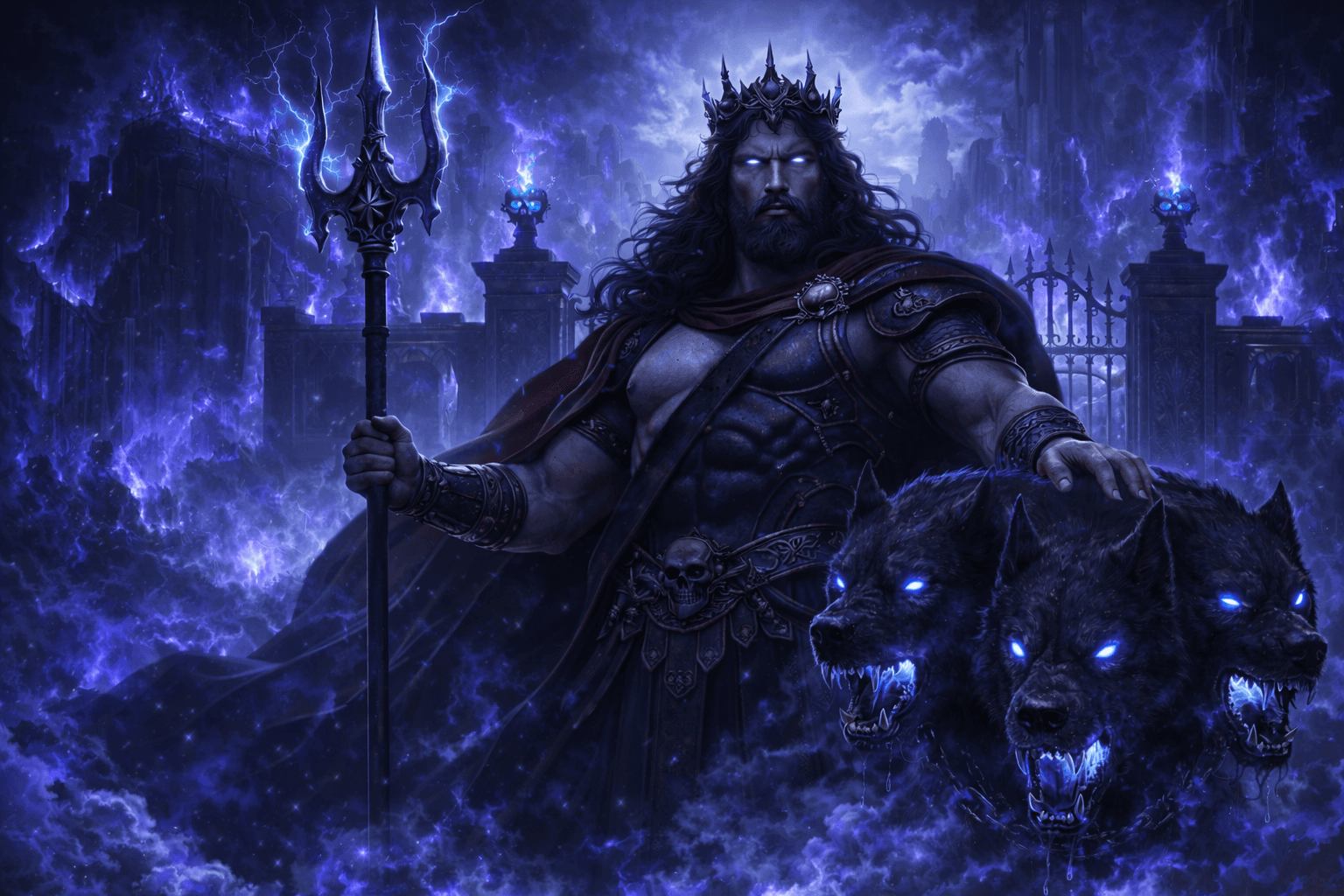
I do not punish the dead.
I keep what the living refuse to face.
— Wicked
Across every culture and every age, humanity has given names and faces to the forces that shape existence. Goddesses and Gods are not distant myths locked in the past — they are living archetypes, expressions of power, consciousness, nature, and cosmic law.
Within the Grimoire, deities are honored as embodiments of specific energies: creation and destruction, love and war, wisdom and chaos, death and rebirth. Each carries their own mythology, symbols, correspondences, and lessons, yet all emerge from the same universal source.
Goddesses appear here first, not as lesser counterparts, but as primordial forces of creation, transformation, and sovereignty. Gods follow as agents of order, motion, and manifestation. Together, they form a divine balance — mirrors of the inner and outer worlds we navigate every day.
This section is a living archive. As the Grimoire grows, so too will the pantheons represented here. Whether you approach these deities through devotion, study, magic, or symbolism, you are stepping into a lineage as old as humanity itself.
Core Essence
Hades is the sovereign of what lies beneath — the keeper of endings, thresholds, and the unacknowledged weight of truth. He is not a god of cruelty or punishment. He is the force of finality, containment, and consequence — the intelligence that ensures nothing escapes reckoning.
His current is still and absolute. Hades governs what cannot be rushed, bargained with, or bypassed. He teaches that transformation does not occur through light alone — it occurs when descent is honored and avoided truths are faced without flinching.
Correspondences
Element
Planetary Association
Day
Chakra
Metal
Mythological Origins
In Greek myth, Hades is the ruler of the Underworld — the unseen realm where all souls must pass. He is not a god of evil, but of order: the keeper of balance between life and death, ensuring that nothing meant to end continues to wander unfinished.
His mythology is quiet, restrained, and absolute. Hades does not chase worship. He does not plead for recognition. His authority is inherent — rooted in inevitability, law, and the unalterable truth that all things return to the source.
Domains & Powers
Hades governs death, endings, inheritance, hidden wealth, deep truth, and the boundaries between worlds. His power reveals what is buried — emotionally, spiritually, psychologically — and brings it into conscious reckoning.
He is especially potent during periods of loss, transition, shadow work, and irreversible change. Hades does not soften reality — he clarifies it.
Symbols & Sacred Imagery
Hades’ symbols include keys, darkness, iron gates, underground rivers, gemstones hidden beneath the earth, and the imagery of descent. His presence is often felt as gravity — a pull inward that demands honesty and stillness.
Hades in Practice
Work with Hades when you are facing endings, grieving losses, confronting shadow material, or reclaiming power that was buried through avoidance or fear. He is essential for boundary work, ancestral reckoning, and deep psychological transformation.
Hades teaches that some doors are meant to close — and that honoring closure is an act of respect, not failure.
How to Know if Hades Has Chosen You
If Hades has chosen you, avoidance stops working. What you buried — grief, truth, resentment, unclaimed power — begins to surface, not to punish you, but to be integrated.
His presence often arrives through enforced stillness: pauses, endings, or moments where something is taken away so that you can see what actually remains. Silence becomes instructive.
Signs may appear through dreams of descent, underground spaces, shadows, ancestral imagery, or a growing comfort with solitude and inner depth.
Most of all, if Hades has chosen you, your life begins to demand honesty with finality. You are asked to stop lingering at doors that have already closed and to claim the authority that comes from accepting what is irrevocable.
Offerings & Devotion
Offer Hades dark wine, clean water, iron tokens, or moments of silence given with respect. He is honored through truth-telling, grief honored without suppression, and the courage to sit with what is difficult instead of escaping it.
Devotion to Hades is inward. It is lived through integrity, acceptance, and the refusal to lie to yourself about what has ended.
Hades vs Pluto
Hades and Pluto are related but distinct. Hades represents the Greek mythic ruler of the dead — structured, restrained, and lawful. Pluto, in the Roman current, emphasizes wealth, power, and transformation through destruction and rebirth.
Treat Hades as the keeper of finality and Pluto as the force of regeneration that follows it.
Archetypal Expression
Hades moves through the Gatekeeper, the Sovereign of Endings, the Keeper of Truth, and the Silent Judge — not as roles to perform, but as currents of power. The Gatekeeper enforces boundaries. The Sovereign of Endings ensures closure. The Keeper of Truth reveals what cannot remain hidden.
In his highest expression, Hades is integrity without compromise — authority that does not need to be loud.
Shadow & Balance
His shadow can appear as emotional isolation, rigidity, suppression, or fear of loss turned into control. When descent becomes avoidance of life rather than engagement with truth, the current distorts.
Hades’ corrective wisdom is direct: face what has ended, and you will be free to live again.
Hades in the Modern World
Today, Hades appears wherever someone chooses truth over denial. He lives in the therapist’s office, the grief ritual, the decision to end what no longer lives. His energy is present whenever silence is honored instead of filled.
He reminds us that death is not the enemy of life — avoidance is.
Closing Reflection
Hades teaches that endings are not failures — they are necessities. What is buried is not erased; it is transformed, integrated, and given weight. His realm is not punishment, but truth without decoration.
He asks you to look honestly at what you have avoided grieving, what you have refused to release, and what power you have hidden because it was inconvenient to hold. Descent is not weakness. It is courage.
Walk with Hades when you are ready to honor closure: to end what must end, to claim what was taken through fear, and to stand firmly in the authority that comes from knowing your limits.
His blessing arrives as depth and stability — a grounded sense of self that does not need approval, and a respect for boundaries that protects both the living and the dead. Through him, you learn that stillness can be power.
Hades reminds you that the underworld is not a place to fear. It is a place to know. When you respect what lies beneath, you gain the strength to walk the surface without illusion.